Artificial Analysis推文
Artificial Analysis 发布 Endpoint Accuracy Index v1.1:新增 GLM-5.3 Flash 等模型评测,近四分之一端点精度低于参考值
Artificial Analysis 发布 Endpoint Accuracy Index v1.1,扩展对 GLM-5.3 Flash 和 Muse Spark Open 等模型的覆盖。评测显示,在 100 多个无服务器端点中,近四分之一得分低于官方自托管参考部署。主要变化包括升级长上下文召回基准 AA-LCR v1.1 并增加重复次数以降低置信区间误差,同时新增六个开源权重模型的对比数据,旨在帮助开发者基于精度而非仅价格选择提供商。
译文
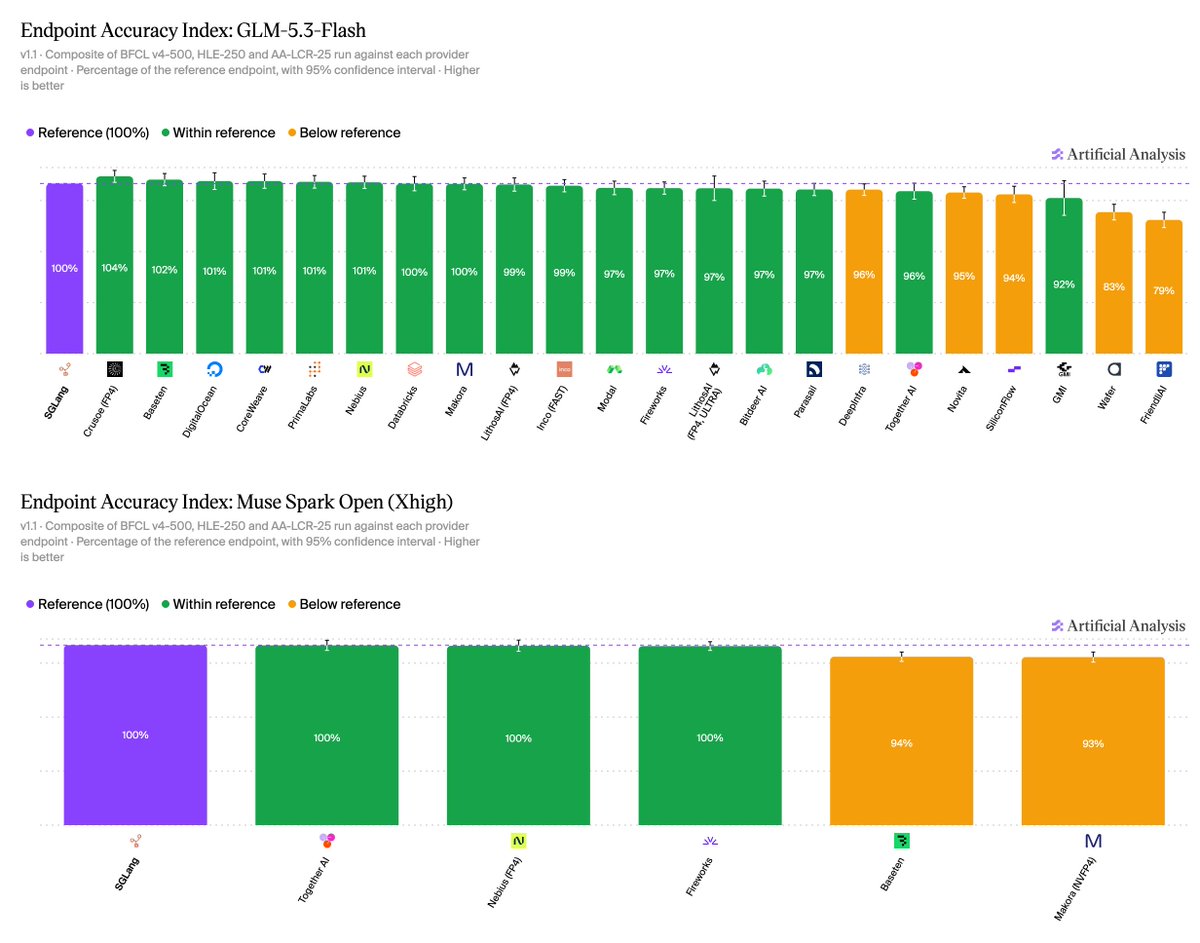
发布 Artificial Analysis Endpoint Accuracy Index v1.1:这是一个小版本升级,同时扩展了对 GLM-5.3 Flash 和 Muse Spark Open 的覆盖范围。在我们基准测试的 100 多个无服务器端点中,近四分之一得分低于参考值。提供商为了优化速度和成本而牺牲准确性。它们对权重进行量化、编写自定义内核、调整推理堆栈并限制输出长度,有时甚至直接发布带有错误的产品。Endpoint Accuracy Index(端点准确率指数)衡量每个端点保留了模型多少准确性,以便开发者仅基于准确性而非价格和速度来选择提供商。我们将每个端点的得分表示为我们官方权重的自托管参考部署的百分比,涵盖工具调用(BFCL-500)、科学推理(HLE-250)和长上下文回忆(AA-LCR-25),各项权重相等。 变化内容: ➤ 将 AA-LCR-25 升级为 AA-LCR v1.1,并将重复次数从 10 次增加到 25 次:AA-LCR v1.1 修正了答案键中的错误和歧义,并将评分移至 GPT-5.6 Luna (medium)。每道题运行 25 次(原为 10 次),将平均 95% 置信区间从 ±4.7 分缩小至 ±2.6 分。 ➤ 覆盖范围扩展至六个开放权重模型:我们新增了 GLM-5.3 Flash (max) 和 Meta 的 Muse Spark Open (xhigh),以及 DeepSeek V4.1 Flash 1017 (max)、GLM-5.3 (max)、Kimi K3 (max) 和 gpt-oss-120b (high)。 关于 GLM-5.3 Flash 的关键要点: ➤ 22 个端点中有 16 个在统计上与参考值一致,其中一个得分高于参考值(104.2)。 ➤ 输出令牌上限限制了模型在复杂任务上的表现:两个将输出令牌限制在约 32K 的端点在生成答案前截断了约一半的 HLE-250 响应,得分分别为 22% 和 29%,而参考值为 55%。 ➤ 推理较少的端点产生的答案质量较低:在 HLE-250 上,两个端点产生的推理令牌比参考值少约 30%,且没有截断现象,得分为 48%,而参考值为 55%。 关于 Muse Spark Open 的关键要点: ➤ 五个端点中有三个与参考值匹配:它们的得分为 99.5 至 99.9,其中包括一个提供 FP4 权重的端点。 ➤ 另外两个端点仅在工具调用上损失了准确性:两者都将工具定义为文本的参数(如预订 ID)返回为数字,在 BFCL-500 上得分为 50% 和 51%,而参考值为 59%。在 HLE-250 和 AA-LCR-25 上,它们的得分与参考值相差在 2 分以内。
Launching Artificial Analysis Endpoint Accuracy Index v1.1: a minor version upgrade alongside expanded coverage for GLM-5.3 Flash and Muse Spark Open. Across the 100+ serverless endpoints we benchmarked, nearly 1 in 4 score below the reference Providers trade off accuracy to optimize for speed and cost. They quantize weights, write custom kernels, tune their inference stacks and cap output lengths, and sometimes they simply ship bugs. The Endpoint Accuracy Index measures how much of a model’s accuracy each endpoint preserves, so developers can pick providers on accuracy, not just price and speed. We score each endpoint as a percentage of our self-hosted reference deployment of the official weights, across tool calling (BFCL-500), scientific reasoning (HLE-250) and long context recall (AA-LCR-25), equally weighted. What’s changed: ➤ Upgraded AA-LCR-25 to AA-LCR v1.1 and increased repeats from 10 to 25: AA-LCR v1.1 corrects errors and ambiguities in answer keys and moves grading to GPT-5.6 Luna (medium). Running each question 25 times, up from 10, reduces the average 95% confidence interval from ±4.7 to ±2.6 points ➤ Expanded coverage to six open weights models: We add GLM-5.3 Flash (max) and Meta’s Muse Spark Open (xhigh), alongside DeepSeek V4.1 Flash 1017 (max), GLM-5.3 (max), Kimi K3 (max) and gpt-oss-120b (high) Key takeaways for GLM-5.3 Flash: ➤ 16 of 22 endpoints are statistically in line with the reference, and one scores above it (104.2) ➤ Output token caps limit the model on complex workloads: Two endpoints capped at ~32K output tokens cut off about half of HLE-250 responses before an answer, scoring 22% and 29% against 55% for the reference ➤ Endpoints that reason less give lower quality answers: Two endpoints produce ~30% fewer reasoning tokens than the reference on HLE-250, with no truncation, and score 48% against 55% Key takeaways for Muse Spark Open: ➤ Three of five endpoints match the reference: They score 99.5 to 99.9, including one serving FP4 weights ➤ The other two lose accuracy only on tool calling: Both return tool arguments that the tool defines as text, such as booking IDs, as numbers, scoring 50% and 51% on BFCL-500 against 59%. On HLE-250 and AA-LCR-25 they are within 2 points of the reference