 DAIR.AI推文
SWE智能体的行为自奖励方法
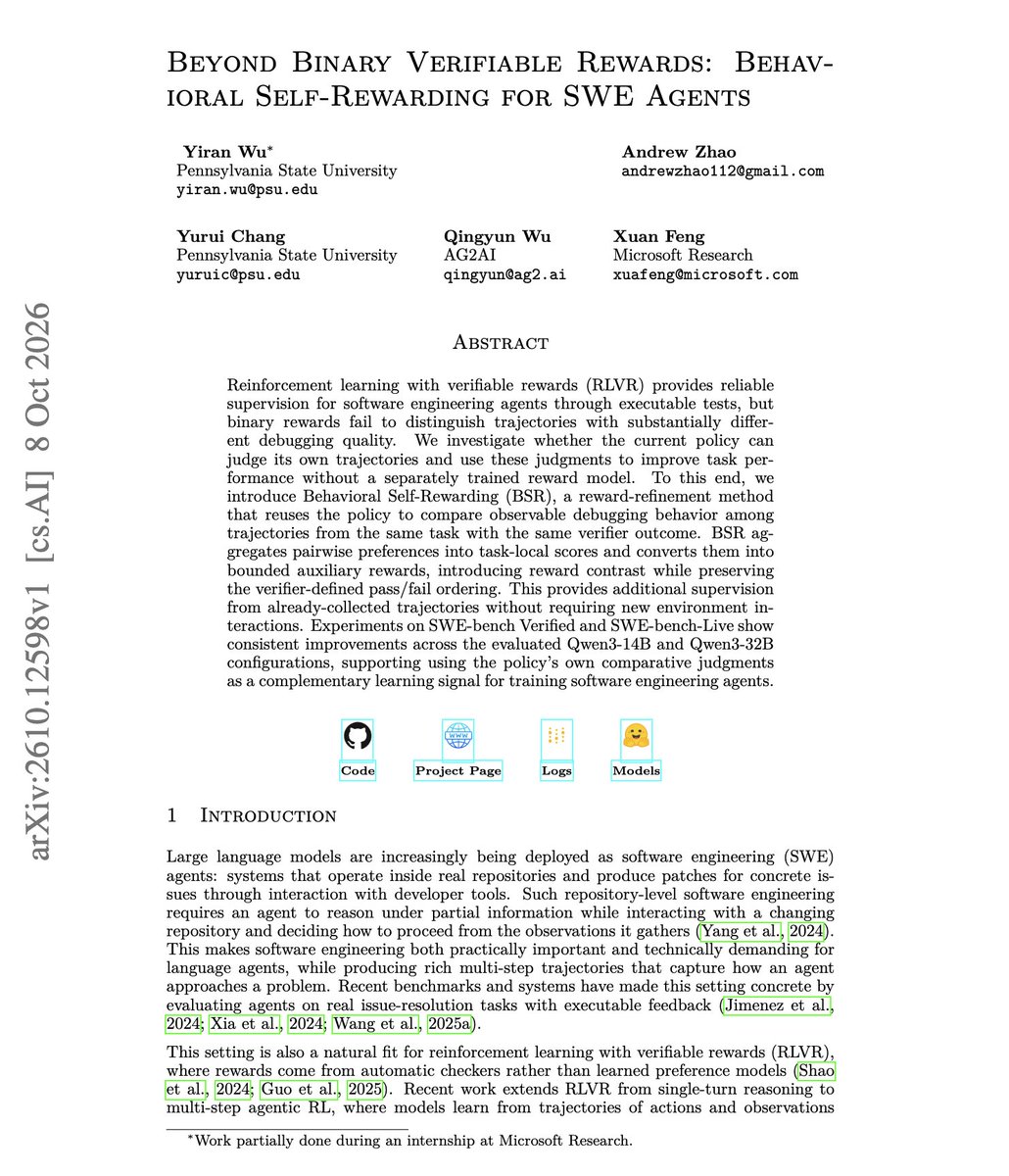
宾州州立大学与微软研究院提出行为自奖励(Behavioral Self-Rewarding),解决SWE智能体训练依赖二元测试奖励导致的对比缺失问题。该方法通过成对比较自身轨迹生成有界偏好奖励,无需新环境交互。在SWE-bench Verified上,Qwen3-14B准确率从32.1%提升至34.7%,Live版从6.33%升至8.11%。
译文
针对软件工程师(SWE)智能体的训练,基于二元测试奖励是标准做法。本文指出了这种做法存在的问题:当一个组内的所有轨迹都通过或全部失败时,奖励缺乏对比性,该组便无法提供任何教学信息。宾夕法尼亚州立大学和微软研究院的研究人员提出了“行为自奖励”(Behavioral Self-Rewarding)方法。策略将自身的轨迹两两进行比较,这些偏好被转化为小的有界奖励,叠加在测试结果之上。由于添加的奖励是有界的,因此自我判断的偏好可以对两个通过的轨迹进行排序,但绝不可能使一个失败的轨迹优于一个通过的轨迹。该方法无需新的环境交互。在 SWE-bench Verified 上,Qwen3-14B 在 400 步预算下的平均准确率从 32.1% 提升至 34.7%,在 SWE-bench-Live 上从 6.33% 提升至 8.11%。https://arxiv.org/abs/2610.12598 论文对话:https://academy.dair.ai/papers/beyond-binary-verifiable-rewards-behavioral-self-rewarding-for-swe-agents-2610.12598
// Behavioral Self-Rewarding for SWE agents // It's standard practice to train SWE agents on binary test rewards. This paper shows the problem with that. When every trajectory in a group passes, or every one fails, the reward has no contrast, and the group teaches nothing. Researchers from Penn State and Microsoft Research propose Behavioral Self-Rewarding. The policy compares its own trajectories in pairs, and those preferences become small bounded rewards added on top of the test result. The added rewards are bounded, so a self-judged preference can rank two passing trajectories but can never lift a failing one above a passing one. No new environment interactions are needed. On SWE-bench Verified, Qwen3-14B improves from 32.1% to 34.7% average accuracy at a 400-step budget, and on SWE-bench-Live from 6.33% to 8.11%. https://arxiv.org/abs/2610.12598 Chat with Paper: https://academy.dair.ai/papers/beyond-binary-verifiable-rewards-behavioral-self-rewarding-for-swe-agents-2610.12598