Artificial Analysis推文
Artificial Analysis 发布决策指数 v2:引入校准奖励机制,私有数据集占比提升至 45%
Artificial Analysis 发布 Decision Index v2,旨在评估模型在真实世界中的效用并防止刷榜。新版本中 45% 的基准来自私有数据集(v1 为 25%)。核心指标 Decision Score 同时考量正确率与置信度校准。新增 AA-Paperclip 文档决策测试、AA-Symmetry 一致性测试及更新后的 Omniscience 和 HLE 基准。Drex Max v1.1 以微弱优势领先决策类模型榜单。
译文
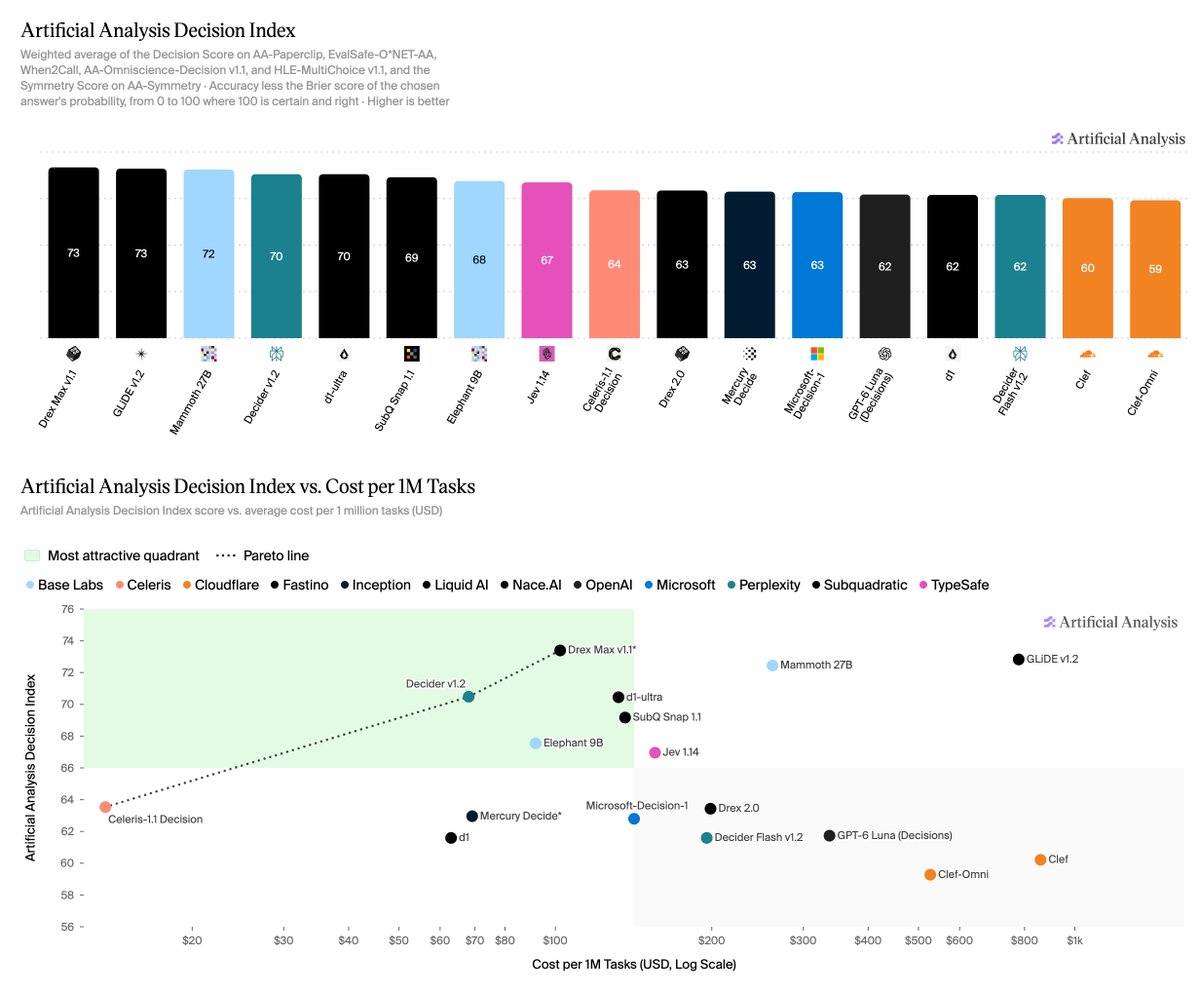
介绍 Artificial Analysis 决策指数 v2:全新的专有评估、更新的基准测试,以及奖励模型校准能力的核心指标。我们发布了第二版 Artificial Analysis 决策指数,以更好地反映实际效用并防止基准测试作弊。该指数的 45% 现在基于私有数据集构建,高于 v1 版本的 25%。来自 @NaceAI 的 Drex Max v1.1 在决策模型中以 73 分微弱领先,与 GLiDE v1.2 (@fastinoAI) 和 Mammoth 27B (@baselabs) 仅相差 1 分。 决策指数 v2 的更新内容: ➤ 决策得分(Decision Score):我们采用了一项新的核心指标,奖励模型在正确性和校准置信度方面的表现。每个问题的评分范围为 0 到 100:答对得 50 分以上,答错得 50 分以下,且对首选答案的置信度会在各自区间内影响最终得分。 ➤ AA-Paperclip(占 30%):我们新增了一个包含 1,500 份文档的私有基准测试,其中包括简历、收据、发票以及人工智能和机器学习研究论文。模型需从每份文档中做出决策并提取事实,作为单一决策进行联合评分,只有当全部 15 个答案都正确时才计分。 ➤ AA-Symmetry(占 15%):此部分评估模型是否会对措辞不同但含义相同的问题给出不同的答案。我们测试了 120 个问题,包括选项重排、标签互换以及否定式是非题等变体,然后衡量模型在这些变体下概率输出的一致性。 ➤ AA-Omniscience-Decision v1.1 和 HLE-MultiChoice v1.1(各占 15%,较之前的 25% 有所下降):AA-Omniscience-Decision 现将其“我不知道”选项的措辞分为十种变体。HLE-MultiChoice 增加了使用相同十种措辞拒绝回答的选项。 我们还新增了 EvalSafe-ONET-AA(占 15%),这是我们对 @typesafeai 的 ONET 基准测试的实现。我们将 @NVIDIAAI 的 When2Call 保留在指数中,但权重降至 10%(此前为 25%),并移除了 WildGuardTest,因其饱和度过高。 关键结果: ➤ 三款决策模型在指数顶端相距不到 1 分:来自 Nace AI 的 Drex Max v1.1 和来自 Fastino Labs 的 GLiDE v1.2 均得 73 分,而来自 Base Labs 的 Mammoth 27B 得 72 分。 ➤ 每百万次任务的成本在不同决策模型间差异超过 60 倍:Celeris-1.1 Decision(14 美元)、Decider v1.2(68 美元)和 Drex Max v1.1(102 美元)位于决策指数与成本的帕累托前沿上,而 Clef 的成本高达 859 美元。代币价格并非唯一的成本驱动因素:大多数决策模型(包括 Drex Max v1.1 和 Decider v1.2)对文档输入仅收取一次费用以处理所有问题,而 GLiDE v1.2 和 Decider Flash v1.2 则对每个问题单独计费。这意味着尽管 GLiDE v1.2 的列表价格仅高出 33%,但其成本为 780 美元,几乎是 Drex Max v1.1 的 8 倍。 ➤ 语言模型可以取得更高的分数,但伴随更高的成本和单次任务时间:Claude Haiku 5.5 (Max) 在决策指数 v2 中得分为 77,GPT-6 Luna (Max) 得分为 76,比 Drex Max v1.1 高出约 3 分。GPT-6 Luna (Max) 每百万次任务成本为 1,530 美元,而 Drex Max v1.1 仅为 102 美元(成本高出 15 倍);单次任务耗时为 11.34 秒,而 Drex Max v1.1 仅需 275 毫秒(速度慢约 40 倍)。
Introducing the Artificial Analysis Decision Index v2: a new proprietary evaluation, updated benchmarks, and a headline metric that rewards model calibration We’ve released the second version of the Artificial Analysis Decision Index to better reflect real-world utility and guard against benchmark gaming. 45% of the Index is now built on private datasets, up from 25% in v1. Drex Max v1.1 from @NaceAI narrowly leads among decision models at 73, within 1 point of GLiDE v1.2 (@fastinoAI) and Mammoth 27B (@baselabs) Updates in Decision Index v2: ➤ Decision Score: We adopt a new headline metric that rewards a model for both correctness and calibrated confidence. Each question scores from 0 to 100: right answers score above 50, wrong answers below 50, and confidence in its top answer moves the score within each half ➤ AA-Paperclip (30%): We added a new private benchmark of 1,500 documents including resumes, receipts, invoices, and AI and machine learning research papers. Models make decisions and extract facts from each document and are scored jointly as a single decision, correct only if all 15 answers are right ➤ AA-Symmetry (15%): This evaluates whether models change their answers for equivalent questions worded differently. We test 120 questions with variations such as reordered options, swapped labels, and negated yes/no questions, then measure how consistent the model’s probabilities are across those variations ➤ AA-Omniscience-Decision v1.1 and HLE-MultiChoice v1.1 (15% each, down from 25%): AA-Omniscience-Decision now varies the wording of its “I don’t know” option across ten alternatives. HLE-MultiChoice adds an option to decline using the same ten phrasings We’ve also added EvalSafe-ONET-AA (15%), our implementation of @typesafeai’s ONET benchmark. We have retained When2Call from @NVIDIAAI in the Index at a decreased weighting of 10% (down from 25%), and removed WildGuardTest given its high saturation Key results: ➤ Three decision models sit within 1 point at the top of the Index: Drex Max v1.1 from Nace AI and GLiDE v1.2 from Fastino Labs both score 73, with Mammoth 27B from Base Labs scoring 72 ➤ Cost per 1M Tasks varies by more than 60x across decision models: Celeris-1.1 Decision ($14), Decider v1.2 ($68) and Drex Max v1.1 ($102) sit on the Decision Index vs. Cost Pareto frontier, while Clef costs $859. Token price is not the only cost driver: most decision models, including Drex Max v1.1 and Decider v1.2, bill a document’s input once for all its questions, while GLiDE v1.2 and Decider Flash v1.2 bill it for every question. This means GLiDE v1.2 costs $780, nearly 8x higher than Drex Max v1.1 despite only 33% higher list prices ➤ Language models can score higher, alongside higher Cost and Time per Task: Claude Haiku 5.5 (Max) scores 77 and GPT-6 Luna (Max) scores 76 on Decision Index v2, putting them ~3 points ahead of Drex Max v1.1. GPT-6 Luna (Max) costs $1,530 per 1M Tasks vs. $102 for Drex Max v1.1 (15x the cost) and takes 11.34 seconds per task vs. 275 milliseconds (~40x slower)