Artificial Analysis推文
NVIDIA Vera Rubin NVL72 基准测试数据公布,能效较 GB300 提升显著
AA-AgentPerf 平台公布了 NVIDIA Vera Rubin NVL72 的初步基准测试结果。该架构在 DeepSeek V4 Pro、V4.1 Flash 等模型上的每兆瓦吞吐量较前代 GB300 NVL72 提升约 2.8 至 5.7 倍。Vera Rubin NVL72 采用 72 颗 Rubin GPU 和 36 颗 Vera CPU,具备更高的内存带宽和计算密度,在保持高并发用户响应速度的同时大幅提升了系统能效。
译文
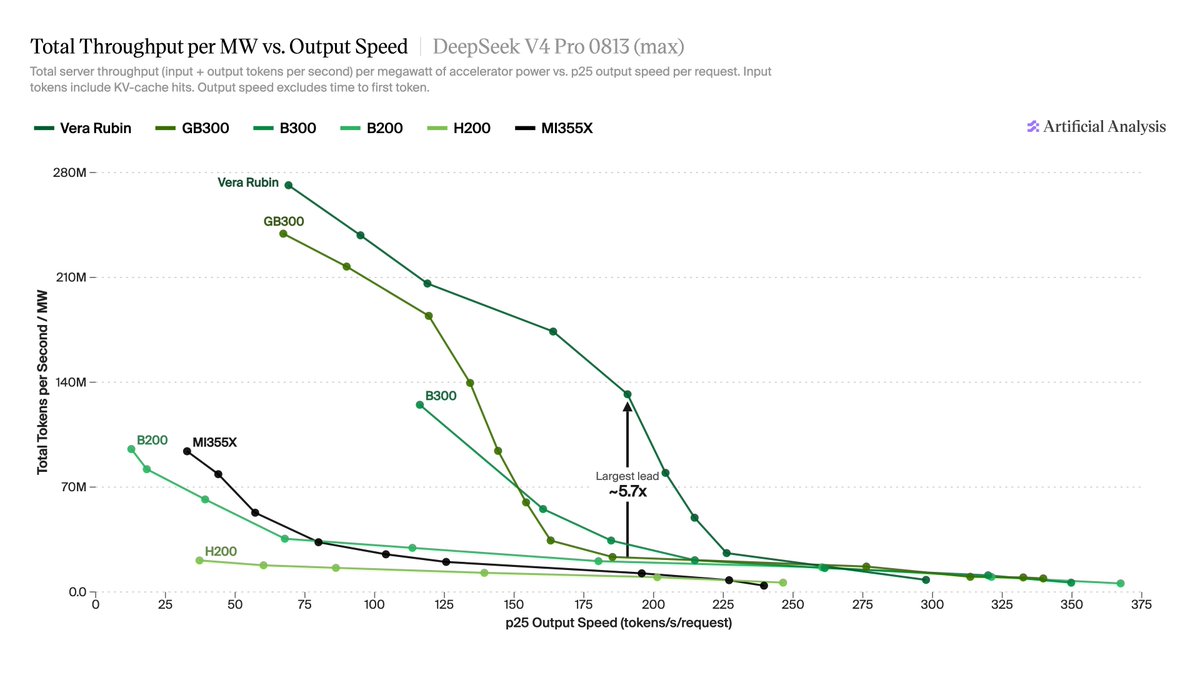
NVIDIA Vera Rubin NVL72 的初步结果现已在 AA-AgentPerf 上发布。在 DeepSeek V4 Pro 上,其每兆瓦总吞吐量最高可达前代 GB300 NVL72 的约 5.7 倍;在 DeepSeek V4.1 Flash 上约为 5.4 倍;在 GLM-5.2 上约为 3.0 倍;在 Kimi K3 上约为 2.8 倍。Vera Rubin 是 NVIDIA Blackwell 的继任者,而 Vera Rubin NVL72 是其机架级系统,配备 72 个 Rubin GPU 和 36 个 Vera CPU。每个 Rubin GPU 拥有与 Blackwell Ultra 相同的 288 GB 内存,但内存带宽提升 2.4 倍,NVLink 带宽提升 1.7 倍,密集 NVFP4 计算能力提升 2.3 倍。NVIDIA 提交了所有 Vera Rubin 的结果,运行环境包括使用 NVIDIA Dynamo 的 TensorRT-LLM 和 vLLM。AA-AgentPerf 是我们的代理推理性能基准测试。它重放真实的代理编码会话,包括长缓存上下文和工具调用延迟,以提供日常代理工作负载中推理性能的 realistic 衡量标准。我们测量每兆瓦实测 GPU 功率的系统总吞吐量,以及不同并发级别下的每代理输出速度(请求间的 p25),以展示系统利用率与单个用户体验之间的权衡。 初步结果: ➤ 在更快的单用户速度下,Vera Rubin 的优势最大,此时 GB300 的吞吐量显著下降。在 DeepSeek V4 Pro 上,将单用户速度从约 120 tok/s 提升至约 165 tok/s,GB300 损失了其每兆瓦吞吐量的 81%,而 Vera Rubin 仅损失 16%。 ➤ 在峰值吞吐量时,两者差距较近:Vera Rubin 在 DeepSeek V4 Pro 上为每兆瓦 2.72 亿 tokens/s,而 GB300 为 2.39 亿(1.14 倍);在 DeepSeek V4.1 Flash 上分别为 5.71 亿 vs 3.95 亿(1.45 倍);在 GLM-5.2 上分别为 2.72 亿 vs 2.01 亿(1.35 倍);在 Kimi K3 上分别为 7000 万 vs 5600 万(1.26 倍)。随着 Vera Rubin 内核及其他服务软件的优化,我们预计两个系统之间的差距将进一步扩大。 ➤ Vera Rubin 在我们的排行榜上创下了 DeepSeek V4.1 Flash(906 tok/s,任何模型中的最快成绩)、GLM-5.2(408 tok/s)和 Kimi K3(255 tok/s)的单用户最快速度。 恭喜 @nvidia 取得强劲成果!阅读完整分析:
Initial results for NVIDIA's Vera Rubin NVL72 are now live on AA-AgentPerf, with up to ~5.7x the total throughput per megawatt of its predecessor GB300 NVL72 on DeepSeek V4 Pro, ~5.4x on DeepSeek V4.1 Flash, ~3.0x on GLM-5.2 and ~2.8x on Kimi K3 Vera Rubin is NVIDIA's successor to Blackwell, and Vera Rubin NVL72 is its rack-scale system, with 72 Rubin GPUs and 36 Vera CPUs. Each Rubin GPU has the same 288 GB of memory as Blackwell Ultra, but 2.4x the memory bandwidth, 1.7x the NVLink bandwidth and 2.3x the dense NVFP4 compute. NVIDIA submitted every Vera Rubin result, running TensorRT-LLM and vLLM with NVIDIA Dynamo AA-AgentPerf is our agentic inference performance benchmark. It replays real agentic coding sessions, including long cached contexts and tool-call delays, to give a realistic measure of inference performance in day-to-day agentic workloads. We measure total system throughput per megawatt of measured GPU power, and per-agent output speed (p25 across requests) at varying concurrency levels, to show the trade-off between system utilization and individual user experience Initial results: ➤ Vera Rubin's lead is largest at faster per-user speeds, where GB300's throughput falls away. On DeepSeek V4 Pro, going from ~120 to ~165 tok/s per user costs GB300 81% of its throughput per MW, compared to 16% for Vera Rubin ➤ At peak throughput the two are closer, with Vera Rubin at 272M tokens/s per MW on DeepSeek V4 Pro vs 239M for GB300 (1.14x), 571M vs 395M on DeepSeek V4.1 Flash (1.45x), 272M vs 201M on GLM-5.2 (1.35x) and 70M vs 56M on Kimi K3 (1.26x). We expect the gap between the systems to widen as Vera Rubin kernels and other serving software are optimized ➤ Vera Rubin sets the fastest per-user speeds on our leaderboard for DeepSeek V4.1 Flash (906 tok/s, the fastest result for any model), GLM-5.2 (408 tok/s) and Kimi K3 (255 tok/s) Congratulations @nvidia on the strong results! Read the full analysis: